


2026 Valid PCNSE FREE EXAM DUMPS QUESTIONS & ANSWERS
Free PCNSE Exam Braindumps Palo Alto Networks Pratice Exam
The PCNSE certification exam is an advanced-level certification that requires a high degree of technical expertise and practical experience in deploying and managing Palo Alto Networks security solutions. PCNSE exam is intended for security professionals with at least three to five years of experience in network security and firewall management. Palo Alto Networks Certified Network Security Engineer Exam certification exam is a comprehensive test that requires candidates to demonstrate their skills in both theoretical and practical aspects of network security.
NEW QUESTION # 107
Which event will happen if an administrator uses an Application Override Policy?
- A. App-ID processing time is increased.
- B. The application name assigned to the traffic by the security rule is written to the Traffic log.
- C. The Palo Alto Networks NGFW stops App-ID processing at Layer 4.
- D. Threat-ID processing time is decreased.
Answer: C
Explanation:
Explanation
Explanation/Reference: https://live.paloaltonetworks.com/t5/Learning-Articles/Tips-amp-Tricks-How-to-Create-an- Application-Override/ta-p/65513
NEW QUESTION # 108
An enterprise network security team is deploying VM-Series firewalls in a multi-cloud environment. Some firewalls are deployed in VMware NSX-V, while others are in AWS, and all are centrally managed using Panorama with the appropriate plugins installed. The team wants to streamline policy management by organizing the firewalls into device groups in which the AWS-based firewalls act as a parent device group, while the NSX-V firewalls are configured as a child device group to inherit Security policies. However, after configuring the device group hierarchy and attempting to push configurations, the team receives errors, and policy inheritance is not functioning as expected. What is the most likely cause of this issue?
- A. Panorama must use the same plugin version numbers for both AWS and NSX-V environments before device group inheritance can function properly
- B. Panorama does not support policy inheritance across device groups containing firewalls deployed in different hypervisors when using multiple plugins
- C. Panorama requires the objects to be overridden in the child device group before firewalls in different hypervisors can inherit Security policies
- D. Panorama by default does not allow different hypervisors in parent/child device groups, but this can be overridden with the command "set device-group allow-multi-hypervisor enable"
Answer: B
Explanation:
Panorama's device group hierarchy supports policy inheritance, but it does not support inheritance across groups with firewalls on different hypervisors (e.g., AWS and NSX-V) when managed by multiple plugins (Option D). AWS and NSX-V firewalls use distinct plugins (e.g., AWS Plugin, NSX Plugin), and Panorama restricts cross-hypervisor inheritance due to differing configurations and contexts, causing errors when pushing policies.
NEW QUESTION # 109
If an administrator wants to decrypt SMTP traffic and possesses the server's certificate, which SSL decryption mode will allow the Palo Alto Networks NGFW to inspect traffic to the server?
- A. SSL Inbound Inspection
- B. SSH Forward Proxy
- C. SMTP Inbound Decryption
- D. TLS Bidirectional Inspection
Answer: A
Explanation:
Reference:
https://www.paloaltonetworks.com/documentation/71/pan-os/pan-os/decryption/configure-ssl-inbound-inspection
NEW QUESTION # 110
An administrator is defining protection settings on the Palo Alto Networks NGFW to guard against resource exhaustion. When platform utilization is considered, which steps must the administrator take to configure and apply packet buffer protection?
- A. Configure and apply Zone Protection Profiles for all egress zones.
Enable Packet Buffer Protection per egress zone. - B. Enable and then configure Packet Buffer thresholds.
Enable Interface Buffer protection. - C. Enable per-vsys Session Threshold alerts and triggers for Packet Buffer Limits.
Enable Zone Buffer Protection per zone. - D. Create and Apply Zone Protection Profiles in all ingress zones.
Enable Packet Buffer Protection per ingress zone. - E. Enable and configure the Packet Buffer Protection thresholds.
Enable Packet Buffer Protection per ingress zone.
Answer: E
Explanation:
Explanation/Reference: https://www.paloaltonetworks.com/documentation/80/pan-os/pan-os/zone-protection-and-dos- protection/configure-zone-protection-to-increase-network-security/configure-packet-buffer-protection
NEW QUESTION # 111
What would allow a network security administrator to authenticate and identify a user with a new BYOD-type device that is not joined to the corporate domain?
- A. an Authentication policy with 'unknown' selected in the Source User field
- B. a Security policy with 'unknown' selected in the Source User field
- C. a Security policy with 'known-user' selected in the Source User field
- D. an Authentication policy with 'known-user' selected in the Source User field
Answer: A
Explanation:
For a network security administrator to authenticate and identify a user with a new BYOD-type device that is not joined to the corporate domain, the most effective method is to use an Authentication policy targeting users not yet identified by the system.
A: an Authentication policy with 'unknown' selected in the Source User field:
* An Authentication policy allows the firewall to challenge unidentified users for credentials. By selecting
'unknown' in the Source User field, the policy targets users who have not yet been identified by the firewall, which would include users on new BYOD devices not joined to the domain.
* Once the user provides valid credentials, the firewall can authenticate the user and map their identity to subsequent sessions, enabling the application of user-based policy rules and monitoring.
This approach ensures that new and unknown devices can be properly authenticated and identified without compromising security or requiring the device to be part of the corporate domain.
NEW QUESTION # 112
An administrator has a requirement to export decrypted traffic from the Palo Alto Networks NGFW to a third-party, deep-level packet inspection appliance.
Which interface type and license feature are necessary to meet the requirement?
- A. Decryption Mirror interface with the associated Decryption Port Mirror license
- B. Virtual Wire interface with the Decryption Port Export license
- C. Decryption Mirror interface with the Threat Analysis license
- D. Tap interface with the Decryption Port Mirror license
Answer: A
Explanation:
Explanation/Reference:
Reference: https://www.paloaltonetworks.com/documentation/71/pan-os/pan-os/decryption/decryption- mirroring
NEW QUESTION # 113
Which operation will impact the performance of the management plane?
- A. Generating a SaaS Application report
- B. Enabling DoS protection
- C. Decrypting SSL sessions
- D. Enabling packet buffer protection
Answer: A
Explanation:
TIPS & TRICKS: REDUCING MANAGEMENT PLANE LOAD:
https://knowledgebase.paloaltonetworks.com/KCSArticleDetail?id=kA10g000000ClSvCAK TIPS & TRICKS: REDUCING MANAGEMENT PLANE LOAD-PART 2:
https://knowledgebase.paloaltonetworks.com/KCSArticleDetail?id=kA10g000000ClU4CAK
NEW QUESTION # 114
Which three fields can be included in a pcap filter? (Choose three)
- A. Rule number
- B. Source IP
- C. Destination IP
- D. Ingress interface
- E. Egress interface
Answer: A,B,C
Explanation:
Explanation
(https://live.paloaltonetworks.com/t5/Featured-Articles/Getting-Started-Packet-Capture/ta-p/72069)
NEW QUESTION # 115
In the following image from Panorama, why are some values shown in red?
- A. sg2 session count is the lowest compared to the other managed devices.
- B. sg2 has misconfigured session thresholds.
- C. us3 has a logging rate that deviates from the administrator-configured thresholds.
- D. uk3 has a logging rate that deviates from the seven-day calculated baseline.
Answer: D
Explanation:
https://docs.paloaltonetworks.com/pan-os/10-2/pan-os-web-interface-help/panorama-web- interface/panorama-managed-devices-summary/panorama-managed-devices-health A metric health baseline is determined by averaging the health performance for a given metric over seven days plus the standard deviation.
NEW QUESTION # 116
An administrator is attempting to create policies tor deployment of a device group and template stack. When creating the policies, the zone drop down list does not include the required zone.
What must the administrator do to correct this issue?
- A. Enable "Share Unused Address and Service Objects with Devices" in Panorama settings
- B. Add the template as a reference template in the device group
- C. Specify the target device as the master device in the device group
- D. Add a firewall to both the device group and the template
Answer: B
Explanation:
Explanation
In order to see what is in a template, the device-group needs the template referenced. Even if you add the firewall to both the template and device-group, the device-group will not see what is in the template. The following link has a video that demonstrates that B is the correct answer.
https://knowledgebase.paloaltonetworks.com/KCSArticleDetail?id=kA10g000000PNfeCAG
NEW QUESTION # 117
Which three authentication services can administrator use to authenticate admins into the Palo Alto Networks NGFW without defining a corresponding admin account on the local firewall? (Choose three.)
- A. TACACS+
- B. Kerberos
- C. RADIUS
- D. SAML
- E. PAP
- F. LDAP
Answer: B,D,F
NEW QUESTION # 118
Refer to the exhibit.
Based on the screenshots above what is the correct order in which the various rules are deployed to firewalls inside the DATACENTER_DG device group?
- A. shared pre-rules
DATACENTER_DG pre-rules
rules configured locally on the firewall
DATACENTER_DG post-rules
shared post-rules
shared default rules - B. shared pre-rules
DATACENTER_DG pre-rules
rules configured locally on the firewall
DATACENTER_DG post-rules
shared post-rules
DATACENTER_DG default rules - C. shared pre-rules
DATACENTER_DG pre-rules
rules configured locally on the firewall
shared post-rules
DATACENTER.DG post-rules
shared default rules - D. shared pre-rules
DATACENTER DG pre rules
rules configured locally on the firewall
shared post-rules
DATACENTER_DG post-rules
DATACENTER.DG default rules
Answer: D
NEW QUESTION # 119
Which GlobalProtect gateway selling is required to enable split-tunneling by access route, destination domain, and application?
- A. iPSec mode
- B. No Direct Access to local networks
- C. Satellite mode
- D. Tunnel mode
Answer: D
Explanation:
https://docs.paloaltonetworks.com/globalprotect/9-1/globalprotect-admin/globalprotect-gateways/split-tunnel-tra
NEW QUESTION # 120
If the firewall is configured for credential phishing prevention using the "Domain Credential Filter" method, which login will be detected as credential theft?
- A. First four letters of the username matching any valid corporate username.
- B. Mapping to the IP address of the logged-in user.
- C. Marching any valid corporate username.
- D. Using the same user's corporate username and password.
Answer: B
Explanation:
Explanation
https://docs.paloaltonetworks.com/pan-os/8-0/pan-os-new-features/content-inspection-features/credential- ention Reference:
https://www.paloaltonetworks.com/documentation/80/pan-os/newfeaturesguide/content-inspection-features/crede phishing-prevention
NEW QUESTION # 121
Which GlobalProtect component must be configured to enable Chentless VPN?
- A. GlobalProtect gateway
- B. GlobalProtect app
- C. GlobalProtect portal
- D. GlobalProtect satellite
Answer: C
Explanation:
Creating the GlobalProtect portal is as simple as letting it know if you have accessed it already. A new gateway for accessing the GlobalProtect portal will appear. Client authentication can be used with an existing one.
https://docs.paloaltonetworks.com/globalprotect/10-1/globalprotect-admin/globalprotect-clientless- vpn/clientless-vpn-overview
NEW QUESTION # 122
Panorama provides which two SD-WAN functions? (Choose two.)
- A. physical network links
- B. data plane
- C. network monitoring
- D. control plane
Answer: B,D
Explanation:
Explanation/Reference:
NEW QUESTION # 123
Which three multi-factor authentication methods can be used to authenticate access to the firewall? (Choose three.)
- A. User certificate
- B. One-time password
- C. Voice
- D. Fingerprint
- E. SMS
Answer: A,B,D
Explanation:
The three multi-factor authentication methods that can be used to authenticate access to the firewall are One-time Password (OTP), User Certificate, and Fingerprint.
One-time Password (OTP) is a form of two-factor authentication in which a token or code is generated and sent to the user over a secure connection. The user then enters the code to authenticate their access.
User Certificate is a form of two-factor authentication in which the user is required to present a valid certificate in order to access the system. The certificate is usually stored on a physical device, such as a USB drive, and is usually issued by the authentication service provider.
Fingerprint is a form of two-factor authentication in which the user is required to present a valid fingerprint in order to access the system. The fingerprint is usually stored on a physical device, such as a fingerprint reader, and is usually issued by the authentication service provider.
NEW QUESTION # 124
Which two statements are true about DoS Protection and Zone Protection Profiles? (Choose two).
- A. Zone Protection Profiles protect egress zones
- B. DoS Protection Profiles are packet-based, not signature-based
- C. DoS Protection Profiles are linked to Security policy rules
- D. Zone Protection Profiles protect ingress zones
Answer: C,D
Explanation:
https://docs.paloaltonetworks.com/pan-os/9-1/pan-os-admin/zone-protection-and-dos-protection/zone-defense/zone-protection-profiles
NEW QUESTION # 125
Which DoS protection mechanism detects and prevents session exhaustion attacks?
- A. Resource Protection
- B. TCP Port Scan Protection
- C. Packet Based Attack Protection
- D. Flood Protection
Answer: A
Explanation:
Explanation/Reference:
Reference: https://www.paloaltonetworks.com/documentation/71/pan-os/pan-os/policy/dos-protection- profiles
NEW QUESTION # 126
A critical US-CERT notification is published regarding a newly discovered botnet. The malware is very evasive and is not reliably detected by endpoint antivirus software. Furthermore, SSL is used to tunnel malicious traffic to command-and-control servers on the internet and SSL Forward Proxy Decryption is not enabled.
Which component once enabled on a perirneter firewall will allow the identification of existing infected hosts in an environment?
- A. Vulnerability Protection profiles applied to outbound security policies with action set to block
- B. File Blocking profiles applied to outbound security policies with action set to alert
- C. Anti-Spyware profiles applied outbound security policies with DNS Query action set to sinkhole
- D. Antivirus profiles applied to outbound security policies with action set to alert
Answer: C
NEW QUESTION # 127
Refer to exhibit.
An organization has Palo Alto Networks NGFWs that send logs to remote monitoring and security management platforms. The network team has reported excessive traffic on the corporate WAN.
How could the Palo Alto Networks NGFW administrator reduce WAN traffic while maintaining support for all existing monitoring/ security platforms?
- A. Forward logs from external sources to Panorama for correlation, and from Panorama send them to the NGFW.
- B. Forward logs from firewalls only to Panorama and have Panorama forward logs to other external services.
- C. Configure log compression and optimization features on all remote firewalls.
- D. Any configuration on an M-500 would address the insufficient bandwidth concerns.
Answer: B
NEW QUESTION # 128
An administrator needs to assign a specific DNS server to one firewall within a device group. Where would the administrator go to edit a template variable at the device level?
- A. Managed Devices > Device Association
- B. Variable CSV export under Panorama > templates
- C. Manage variables under Panorama > templates
- D. PDF Export under Panorama > templates
Answer: C
Explanation:
To edit a template variable at the device level, you need to go to Manage variables under Panorama > templates. This allows you to override the default value of a variable for a specific device or device group. For example, you can assign a specific DNS server to one firewall within a device group by editing the ${dns-primary} variable for that device. Reference: https://docs.paloaltonetworks.com/panorama/10-1/panorama-admin/manage-firewalls/manage-templates/use-template-variables.html
NEW QUESTION # 129
Which three log-forwarding destinations require a server profile to be configured? (Choose three)
- A. Syslog
- B. SNMP Trap
- C. RADIUS
- D. Kerberos
- E. Panorama
- F. Email
Answer: A,B,F
NEW QUESTION # 130
If a template stack is assigned to a device and the stack includes three templates with overlapping
settings, which settings are published to the device when the template stack is pushed?
- A. All the settings configured in all templates.
- B. Depending on the firewall location, Panorama decides with settings to send.
- C. The administrator will be promoted to choose the settings for that chosen firewall.
- D. The settings assigned to the template that is on top of the stack.
Answer: D
NEW QUESTION # 131
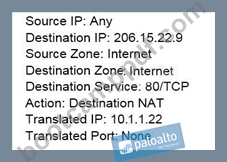
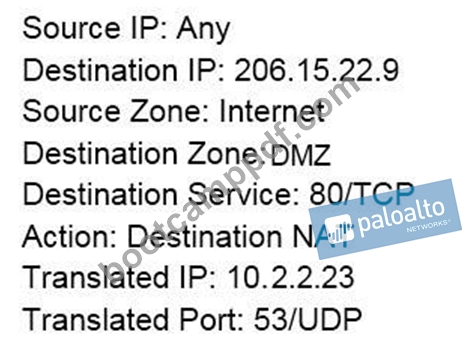
An administrator wants multiple web servers in the DMZ to receive connections initiated from the internet. Traffic destined for 206.15.22.9 port 80/TCP needs to be forwarded to the server at
10.1.1.22.
Based on the information shown in the image, which NAT rule will forward web-browsing traffic correctly?
- A.

- B.
- C.
- D.

Answer: B
Explanation:
You should distinguish questions for NAT and security rules (the only difference in destination zone - Internet for NAT rules and DMZ for policy rules).
NEW QUESTION # 132
......
All in all, the PCNSE exam topics are highlighted as the following:
- Operate (20%)
The topic requires that the learners have the skills in identifying problems for defining visible log forwarding as well as interpreting reports, log files, and graphs to manage exchange and threat trends. Being able to identify situations that have a profit from utilizing custom signatures and the manner to update a Palo Alto Networks system to the newest version of software is also essential for an individual.
You have to know how arrangement management procedures are applied to assure aspired operational state of stability & continuity and how to develop the firewall to mix with AutoFocus & confirm its functions. Additionally, this part validates one’s understanding of the correlation within Panorama and tools as concerning active updates versions and system implementation and/or HA equals, the roots of information that pertain to HA functionality, as well as the settings related to critical HA functions.
- Plan (16%)
The questions from this domain validate the students' ability to identify the notions, such as how the Palo Alto Networks products operate mutually to recognize and stop threats and how to utilize template stacks & design group hierarchy for operating Palo Alto Networks firewalls as a scalable resolution with the help of Panorama. In addition, they have to distinguish the relevant interface model and arrangement for specified system positioning as well as approaches for maintaining logs utilizing Distributed Log Collection. Planning considerations unusual to extending Palo Alto Networks firewalls in hybrid, public, and private Clouds is another ability that they should possess.
The test takers should ascertain opinions for authorization, device administration, and authentication, as well as methods of authentication production on the firewall. It is important to have knowledge of the alternatives eligible in the firewall to maintain progressive routing, decryption deployment strategies, ways of the User-ID redistribution, and advantages of adopting dynamic user groups in policy rules. It is advisable to recognize the items for which you must plan when deploying SD-WAN, VM-Series bootstrap components and their function, and the influence of utilization override to the general functions of the firewall.
- Core Concepts (23%)
This is the last objective of the exam that measures your expertise in identifying the exact position of policy measuring according to the packet flow architecture as well as identifying the major functions staying on the management level and data level of Palo Alto Networks Firewall. It is required to identify the proper PaloAlto Networks threat preventive element to stop or decrease the attack and recognize the proper Palo Alto Networks threat interception component to stop or decrease the attack with the help of a given scenario toward firewall resources.
The candidates need to express their ability to identify the methods for classifying users, dependencies for completing MFA, and techniques for simplifying the configuration of a firewall. They have to know how to define the policies and relevant objects, forward traffic, and control bandwidth utilization on a per-application basis with a given scenario. Also, their skills in defining the pros & cons of using distributed networking with SD-WAN and identifying how the Panorama commit recovery feature functions are tested as well.
- Deploy and Configure (23%)
This subject area measures the applicants’ knowledge of identifying the application purposes in Traffic log, connection within URL filtering and certification theft prevention, and production of safety rules to perform App-ID without depending on port-based practices. A potential candidate has to know about the expected settings and actions essential to deploy and plan a next-generation firewall and various techniques for authorization, authentication, and device management in PAN-OS software for relating to the firewall.
Moreover, the examinees have to know how to design a virtual router, interface as a DHCP relay agent, frames for site-to-site VPN & GlobalProtect, characteristics of NAT system rules, VM-Series firewalls for implementation, and firewalls to utilize tags and filtered log sending for combination by system automation. Besides that, it is important to configure and maintain the certificates to verify the firewall features, identify the peculiarities that support IPv6, as well as implement and maintain the App-ID adoption, among others.
- Configuration Troubleshooting (18%)
This section evaluates the students’ ability to identify operation and traffic problems utilizing the CLI devices and web interface, give a session production, recognize the configuration elements used to implement packet capture, and identify problems by the certificate chain of trust. They should know how to observe GlobalProtect troubleshooting information, resolve when an SD-WAN path has failed, and sort out SSL decoding failures. Furthermore, they need to know how to solve and configure interface elements, determine traffic routing concerns, and identify ACC chart activities.
Prepare For Realistic PCNSE Dumps PDF - 100% Passing Guarantee: https://examcollection.bootcamppdf.com/PCNSE-exam-actual-tests.html