


[Jun 21, 2026] 100% Real & Accurate 300-630 Questions with Free and Fast Updates
Self-Study Guide for Becoming an Implementing Cisco Application Centric Infrastructure - Advanced Expert
NEW QUESTION # 30
Refer to the exhibit. A customer implements Cisco ACI Multi-Site with default MTU settings between two sites. Which configuration should be applied on the interface Eth1/10 on the ISN-1 device?
- A.

- B.

- C.

- D.

Answer: B
NEW QUESTION # 31
In a Cisco ACI Multi-Site fabric, the Inter-Site BUM Traffic Allow option is enabled in a specific stretched bridge domain. What is used to forward BUM traffic to all endpoints in the same broadcast domain?
- A. ingress replication on the spines in the source site
- B. egress replication on the destination leaf switches
- C. egress replication on the source leaf switches
- D. ingress replication on the spines in the destination site
Answer: D
Explanation:
Section: Multisite
Explanation/Reference: http://yves-louis.com/DCI/?p=1277
NEW QUESTION # 32
Refer to the exhibit.
A customer experiences resource overconsumption on one of its border leaf switches. Which action should be taken to reduce the consumption on this switch?
- A. Migrate L3Outs to another switch
- B. Disable Remote EP Learning
- C. Disable VRF Policy Control Enforcement
- D. Disable IP Data Plane Learning
Answer: D
NEW QUESTION # 33
The engineer notices frequent MAC and IP address moves between different leaf switch ports. Which action prevents this problem from occurring?
- A. Enable rogue endpoint control.
- B. Disable enforce subnet check.
- C. Enable endpoint loop protection.
- D. Disable IP bridge domain enforcement.
Answer: A
NEW QUESTION # 34
In a Cisco ACI Multi-Site fabric, the Inter-Site BUM Traffic Allow option is enabled in a specific stretched bridge domain. What is used to forward BUM traffic to all endpoints in the same broadcast domain?
- A. ingress replication on the spines in the destination site
- B. ingress replication on the spines in the source site
- C. egress replication on the destination leaf switches
- D. egress replication on the source leaf switches
Answer: B
Explanation:
In a Cisco ACI Multi-Site fabric, when the Inter-Site BUM Traffic Allow option is enabled in a specific stretched bridge domain, ingress replication on the spines in the source site is used to forward Broadcast, Unknown unicast, and Multicast (BUM) traffic to all endpoints in the same broadcast domain. This method ensures that BUM traffic is efficiently replicated across the fabric, reaching all relevant endpoints without overwhelming the network with unnecessary traffic4.
References := Solved: Cisco ACI Multipod - BUM traffic - Cisco Community.
NEW QUESTION # 35
Refer to the exhibit.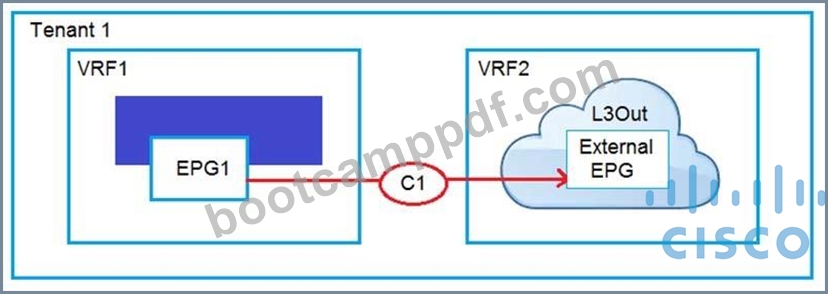
An engineer must have communication between EPG1 in VRF1 and External EPG in VRF2. Which three actions should be taken for the defined subnets in the L3Out External EPG to accomplish this goal? (Choose three.)
- A. Enable Shared Route Control Subnet
- B. Enable Aggregate Shared Routes
- C. Enable Import Route Control Subnet
- D. Enable External Subnets for External EPG
- E. Enable Shared Security Import Subnet
- F. Enable Export Route Control Subnet
Answer: C,E,F
NEW QUESTION # 36
A leaf receives unicast traffic that is destined to an unknown source, and spine proxy is enabled in the corresponding bridge domain. Drag and drop the Cisco ACI forwarding operations from the left into the order the operation occurs on the right.
Answer:
Explanation:
NEW QUESTION # 37
Which two actions should be taken to ensure a scalable solution when multiple EPGs in a VRF require unrestricted communication? (Choose two.)
- A. Set the EPGs that require unrestricted communication between each other as preferred group members.
- B. Configure a taboo contract between the EPGs that require unrestricted communication between each other.
- C. Set the EPGs that require policy enforcement between each other as preferred group members.
- D. Enable Preferred Group Member under the EPG Collection for VRF section.
- E. Set the VRF policy control enforcement preference to Unenforced.
Answer: A,D
Explanation:
For unrestricted communication between multiple EPGs within a VRF, setting them as preferred group members is essential for scalability. Option B, "Enable Preferred Group Member under the EPG Collection for VRF section," allows all EPGs within this collection to communicate without restrictions by default. Option D, "Set the EPGs that require unrestricted communication between each other as preferred group members," designates these groups for unrestricted intercommunication. References := Implementing Cisco Application Centric Infrastructure Official Cert Guide
NEW QUESTION # 38
The engineer notices frequent MAC and IP address moves between different leaf switch ports. Which action prevents this problem from occurring?
- A. Disable enforce subnet check.
- B. Disable IP bridge domain enforcement.
- C. Enable endpoint loop protection.
- D. Enable rogue endpoint control.
Answer: C
Explanation:
Enabling endpoint loop protection is the action that prevents frequent MAC and IP address moves between different leaf switch ports. This feature helps to identify and mitigate loops within the network, which can cause these frequent address moves. By detecting and blocking the looped interfaces, it stabilizes the network and stops the address flapping.
NEW QUESTION # 39
Refer to the exhibit.
A customer experiences resource overconsumption on one of its border leaf switches. Which action should be taken to reduce the consumption on this switch?
- A. Disable IP Data Plane Learning
- B. Disable Remote EP Learning
- C. Migrate L3Outs to another switch
- D. Disable VRF Policy Control Enforcement
Answer: C
Explanation:
To address resource overconsumption on a border leaf switch, migrating L3Outs to another switch can help distribute the load and reduce strain on the affected switch.
References := Implementing Cisco Application Centric Infrastructure Official Cert Guide
NEW QUESTION # 40
The servers are dual-homed to Cisco ACI Leaf1001 and Leaf1002 and must be connected in an active-active mode. The server NICs do not support LACP. These settings have already been configured on the Cisco ACI:
- interface policy group type Leaf Access Port named active-active-
noLACP
- three port selectors: port-1, port-2, and port-3
- AEP called active-active-noLACP has three associated EPGs: EPG-A,
EPG-B, and EPG-C
Which action must be taken to migrate the server ports to a different leaf switch in the event of a catastrophic failure?
- A. Configure the AEP on a physical domain.
- B. Enable Port Tracking under System Settings.
- C. Configure failover VLANs in the VLAN pool.
- D. Enable IP Data Plane Learning.
Answer: B
NEW QUESTION # 41 
Refer to the exhibit. An engineer extends a Cisco ACI Multi-Pod setup to a Cisco ACI Multi-Site implementation. Which action allows the interconnection?
- A. Use dedicated uplinks on Site 1 spines for ISN connections
- B. Configure BIDIR-PIM in the IPN and ISN
- C. Filter the advertisement of the Site 2 TEP pool into the IPN
- D. Connect all spines to the IPN and ISN
Answer: B
Explanation:
Section: Multisite
NEW QUESTION # 42
Drag and Drop Question
Refer to the exhibit. Drag and drop the subnets and flags from the left into the External Network Instance Profile policies on the right to create a setup that advertises only 10.10.0.0/24 and
10.10.1.0/24 prefixes in VRF1 and establishes connectivity between VRFs. Not all options are used.

Answer:
Explanation:
NEW QUESTION # 43
How is the traffic directed to the firewall pair in a two-site Multi-Pod deployment with an active/standby firewall pair stretched across pods?
- A. to the pod designated as the primary pod
- B. to the local service node for processing
- C. to a collector in the Inter-Pod Network
- D. to the pod with the active service node
Answer: B
NEW QUESTION # 44
Which approach does Cisco ACI use to achieve multidestination packet forwarding between leaf switches in the same fabric?
- A. Map VXLAN VNI to the multicast group
- B. Map VXLAN to PIM-DM protocol
- C. Map VXLAN to PIM-SM protocol
- D. Map VXLAN VTEP to the multicast group
Answer: A
NEW QUESTION # 45
An engineer implements the Cisco ACI solution and needs to confirm that the leaf switch correctly learns the remote endpoint MAC. Which information must be included in the VXLAN packet that is received from the Cisco ACI spine for the Cisco ACI leaf to learn MAC as a remote endpoint?
- A. bridge domain
- B. EPG
- C. application profile
- D. VRF
Answer: A
Explanation:
For a Cisco ACI leaf switch to correctly learn the remote endpoint MAC, the VXLAN packet received from the Cisco ACI spine must include bridge domain information. The bridge domain contains the Layer 2 forwarding context, which allows the leaf switch to learn and associate the MAC address with the correct bridge domain3.
References := ( Implementing Cisco Application Centric Infrastructure Official Cert Guide )
NEW QUESTION # 46 
An organization migrates its virtualized servers from a legacy environment to Cisco ACI. VM1 is incorrectly attached to PortGroup IT|3TierApp|Web. Which action limits IP address learning in BD1?
- A. Enable Rouge Endpoint Control
- B. Enable GARP-based EP Move Detection Mode
- C. Enable Enforce Subnet Check
- D. Disable Remote EP Learn
Answer: C
Explanation:
To limit IP address learning in BD1 when VM1 is incorrectly attached to a PortGroup, enabling the Enforce Subnet Check is the correct action. This feature ensures that only IP addresses belonging to the defined subnets under the bridge domain are learned, preventing incorrect IP data from being disseminated across the network. References := ( Implementing Cisco Application Centric Infrastructure Official Cert Guide )
NEW QUESTION # 47
Refer to the exhibit.
An engineer extends a Cisco ACI Multi-Pod setup to a Cisco ACI Multi-Site implementation. Which action allows the interconnection?
- A. Use dedicated uplinks on Site 1 spines for ISN connections
- B. Configure BIDIR-PIM in the IPN and ISN
- C. Filter the advertisement of the Site 2 TEP pool into the IPN
- D. Connect all spines to the IPN and ISN
Answer: B
NEW QUESTION # 48
Refer to the exhibit.
How are the STP BPDUs forwarded over Cisco ACI fabric?
- A. Cisco ACI fabric drops all STP BPDUs that are generated by the external switches.
- B. STP BPDUs that are generated by Switch2 are received by Switch1 and Switch3.
- C. Cisco ACI acts as the STP root for all three external switches.
- D. STP BPDUs that are generated by Switch1 are received only by Switch3.
Answer: B
NEW QUESTION # 49
Refer to the exhibit.
Which configuration must be implemented to allow intra-VRF transit routing between the two external routers?
- A. Configure OSPF virtual links
- B. Change one of the areas to area 0
- C. Modify L3Out 1 to use the same OSPF area as L3Out 2
- D. Deploy both areas under the same L3Out policy
Answer: A
Explanation:
For intra-VRF transit routing between two external routers in different OSPF areas, OSPF virtual links are required. They connect non-contiguous areas to the backbone area, ensuring all areas can communicate even if not directly connected.
References := Implementing Cisco Application Centric Infrastructure Official Cert Guide
NEW QUESTION # 50
Refer to the exhibit.
Which combination of flags in the Cisco ACI contract allows a client in WebClient EPG to establish an HTTP connection toward a server in WebServer EPG?
- A. Apply Both Direction DISABLED and Reverse Port Filter ENABLED
- B. Apply Both Direction DISABLED and Reverse Port Filter DISABLED
- C. Apply Both Direction ENABLED and Reverse Port Filter DISABLED
- D. Apply Both Direction ENABLED and Reverse Port Filter ENABLED
Answer: A
Explanation:
In Cisco ACI, contracts define the policies for communication between EPGs (Endpoint Groups). For a client in WebClient EPG to establish an HTTP connection toward a server in WebServer EPG, the contract must allow the initiation of communication from WebClientto WebServer. Since HTTP uses port 80, the destination port (DST Port) should be set to 80 as per standard HTTP communications. The option "Apply Both Direction DISABLED" means that only the initiator of the connection (in this case, WebClient EPG) can send traffic unless specified otherwise by another contract or filter. The "Reverse Port Filter ENABLED" allows return traffic from WebServer EPG back to WebClient EPG on dynamically allocated source ports used by WebClient when initiating the connection. This combination ensures that clients can initiate an HTTP request and receive responses from servers. References: = Implementing Cisco Application Centric Infrastructure Official Cert Guide
NEW QUESTION # 51
Which feature should be disabled on a bridge domain when a default gateway for endpoints is on an external device instead of a Cisco ACI bridge domain SVI?
- A. unknown unicast flooding
- B. unicast routing
- C. ARP flooding
- D. proxy ARP
Answer: C
Explanation:
ARP flooding should be disabled on a bridge domain when the default gateway for endpoints is on an external device instead of a Cisco ACI bridge domain SVI. This is because ARP flooding allows for the resolution of IP addresses to MAC addresses within the bridge domain. When the default gateway is external, enabling ARP flooding can lead to unnecessary broadcast traffic on the network, as the ARP requests will not be contained within the ACI fabric. Disabling ARP flooding ensures that ARP requests are handled by the external device serving as the default gateway1234.
References := Implementing Cisco Application Centric Infrastructure Official Cert Guide
NEW QUESTION # 52
......
300-630 Study Guide Realistic Verified 300-630 Dumps: https://examcollection.bootcamppdf.com/300-630-exam-actual-tests.html